Written Approval for Forklift Attachments is Required
Forklift Attachments are required to be approved by the manufacturer of the forklift. This is a little noticed rule in OSHA that needs a bit more attention. Let’s take a look at what is required and where the details are to help you understand how to meet the rule.
OSHA 1910.178
OSHA 1910.178 is the industrial code that addresses Power Industrial Trucks, or forklifts. It’s a wide ranging rule written broadly to bring everything under the big tent of this rule. It’s not just your mast forklifts in a warehouse. Put forks on a front end loader and suddenly you need to meet the same codes under 1910.178 for how you are operating and documenting. Let’s see this from the traditional forklift operations perspective and look at the codes accordingly. Just know that it’s more broad than the rest of the discussion here would make one think.
ANSI A56.1 Guides Us
ANSI stands for American National Standards Institute is a national consensus standard governed by ASME, the American Society of Mechanical Engineers. The A56.1 is the code that addresses Power Industrial Trucks (PIT) or forklifts. This document guides all Manufacturers, Owners, and Operators as to their roles, rules and responsibilities. Sometimes you’ll hear the citation of the General Duty Clause. This clause is OSHA’s directive to keep employees safe from all “recognized hazards”. The ANSI and ASME standards are recognized by OSHA as the national standards. They will refer to these standards when they don’t have a specific rule to enforce employee safety standards. It sets a floor for OSHA and keeps up with industry better than OSHA’s codes can on their own.
ANSI A56.1 is cited in OSHA 1910.178. 1910.178 (a)(2)
All new powered industrial trucks acquired and used by an employer shall meet the design and construction requirements for powered industrial trucks established in the “American National Standard for Powered Industrial Trucks, Part II, ANSI B56.1-1969”,
This standard has adopted ANSI specifically as the code for all forklift operations. If you are using forklifts, you need to be aware of the ANSI Standard and incorporate it in your safety plan.
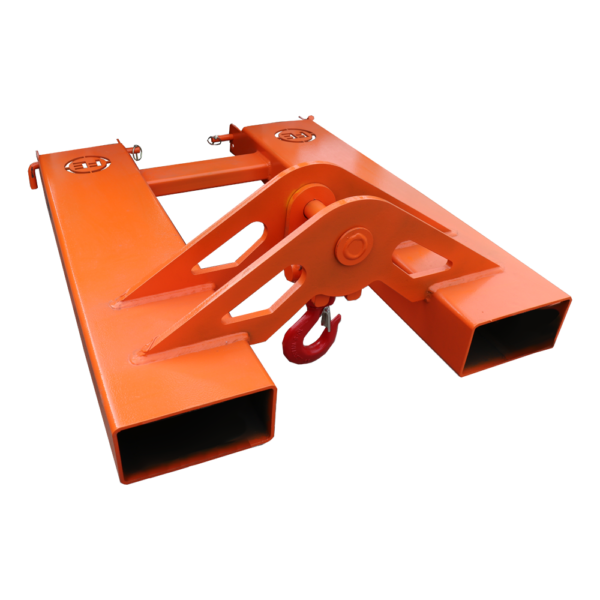
Forklift Spreader Hook Model 2086
Front End Attachments
Front End Attachments on a forklift can be an item that is mounted to the mast in place of the forks, or they can be an on the fork attachment as simple as fork extensions. If it didn’t come from the factory, you need their approval to use it. If it changes the loading of the forklift, or might dislodge a fork tine if it’s the wrong application, the effects can be a matter of life and death. Fork extensions for example shouldn’t add more than 50% to the length of a fork tine. So if your tine is 4’ to begin with, it shouldn’t be longer than 6’ even with an extension. It puts too much weight on the front of the tine, and pushes the center of gravity out further on the forklift. It might be that you have a 5000 lb forklift with a load 2’ from the mast. If you put 5000 lbs out 3 feet, your over turning moment has increased by 50% despite the load not increasing. Under braking or on slopes, you lose stability for an innocent change. And this is why OSHA requires a manufacturer gets involved. The end result is you need:
Chart or diagram with the attachment.
Weight of the truck and attachment at maximum elevation with load laterally centered.
ANSI defines Attachments as:
A device other than conventional forks or load backrest extension mounted permanently or removeably on the elevating mechanism of a truck for handling the load. Popular types of fork extensions, clamps, rotating devices, side shifters, load stabilizers, rams, and booms.
It goes on to know that these can be removable as well.
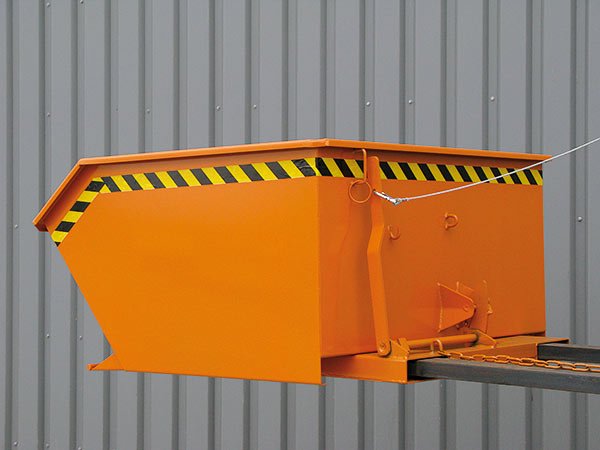
Forklift Hopper as a Forklift Attachment

Forklift Jib as a Forklift Attachment - Changes Center of Gravity
OSHA Letters of Interpretation on Forklift Attachments
OSHA’s Letters of Interpretation on Forklift Attachments include a 2000 (year) letter seeking clarity on the 1910.178 rule and written approval from the manufacturer. OSHA replies that an “addition” that affects capacity and operation requires the approval. To put this in perspective, if you go from having a forklift designed to hold a pallet of goods rated at 5000 lbs, and you change to a jib that is capable of 5000 lbs, but now it’s suspended on a sling that can swing and reach out to 12’, should a qualified person look at the rating to see what it should be derated to? It’s a pretty obvious answer at this point. While it might feel like it’s a bit much for proper operations, we can’t suggest common sense is the safety standard. The rule requires guidance and review.
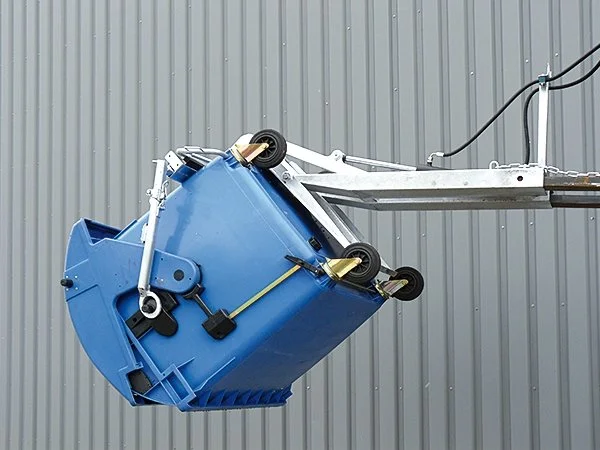
Hydraulic Dumpster Tipper
Compliance and the Benefit of a Forklift Attachment Manufacturer
Forklift Attachment manufacturers like Eichinger can provide drawings and weights with their equipment. If you are buying from unknown manufacturers on third party hosting sites, will you get the data you need to legally accomplish what you need to do to comply with OSHA 1910.178? When you reach out to the dealer like ForkliftGear.net for a purchase, you can expect the support you need. Brochure. Diagram. Loads. Even a chart for some items that need it. Reliance on the low price can get you a lifter that looks the same as another, But if you don’t have the data you need, you’ll be out of compliance. It’s not just the citation for being out of compliance that should keep risk managers up at night. It’s that if anything goes wrong and you can’t show that you didn’t do your part to comply with ANSI, the risk is significant judgements in the face of an injury. Saving 50% of the cost will seem silly if the risk exposure of not following OSHA’s guidance leads to a 6 or 7 figure lawsuit. Get your work tools from reputable dealers with the manufacturer support that will mitigate the unseen risks. Not all risks are in the load chart. We’ll help protect you from the unseen risks as well with compliance built into every sale.